
Attic Mold Inspection in Smyrna, GA: Roof Leaks, Ventilation & Hidden Growth
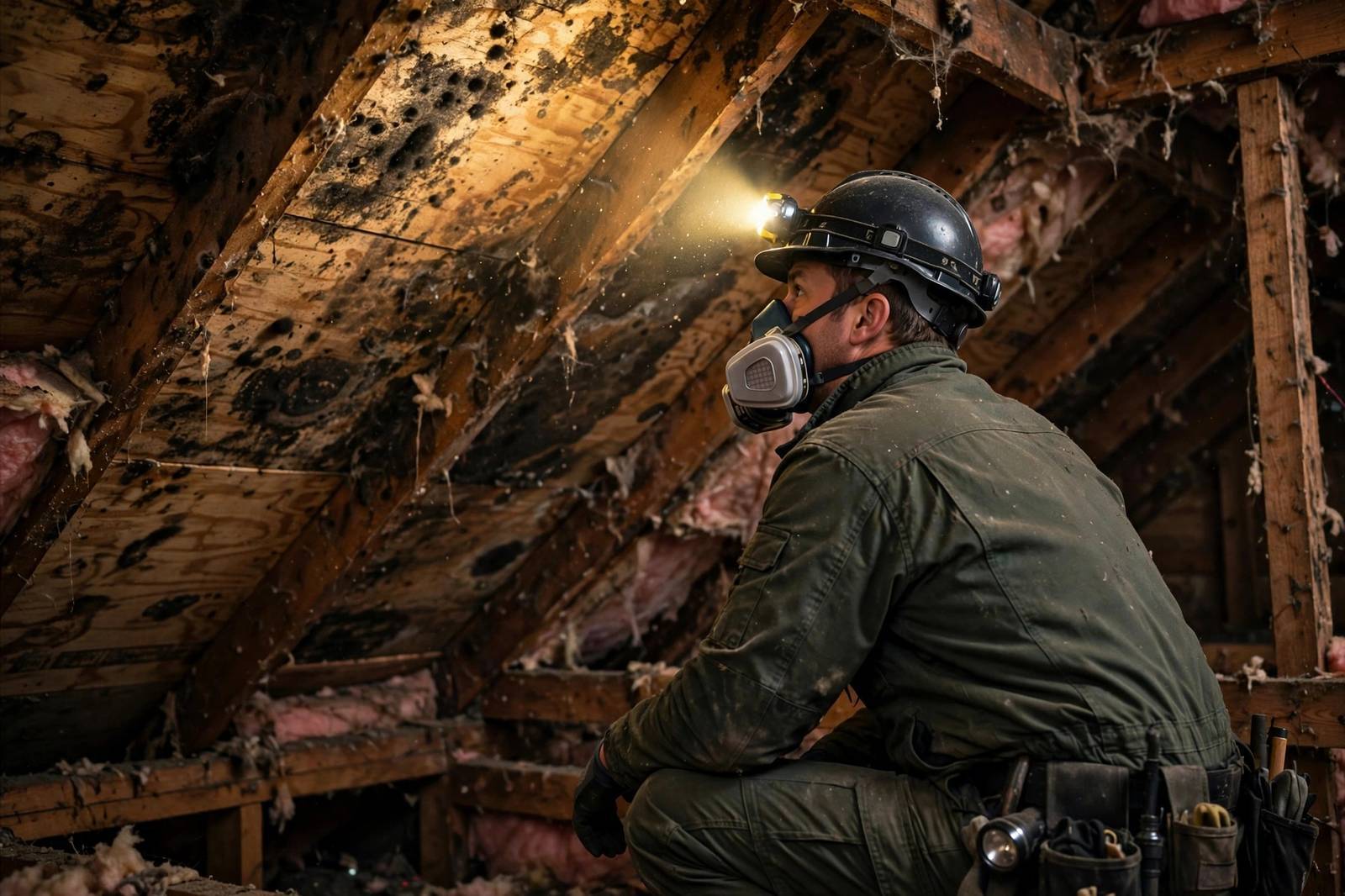
The attic is the most overlooked mold zone in Smyrna, GA homes — and one of the most common. Homeowners rarely go up there. Roof leaks develop slowly. Ventilation imbalances silently pump moisture into the space. By the time a ceiling stain appears in a bedroom below, mold may have been colonizing the roof sheathing for seasons. In a city of 1940s–60s brick ranch homes with aging roofs, humid subtropical air, and ~50 inches of annual rainfall, attic mold is less a possibility than a probability for homes that haven't been professionally assessed.
 Independent • Third-Party
Smyrna Mold Inspection provides thorough attic mold inspections across Smyrna and Cobb County — roof-leak tracing, ventilation analysis, sheathing assessment, moisture mapping, and accredited third-party lab sampling. If you've spotted a ceiling stain, smelled mustiness on the upper floor, or you're buying one of Smyrna's classic ranch homes, call (770) 542-0091. What's above your ceiling affects everything below it.
Why Attics Grow Mold in Smyrna, Georgia
Attic mold needs the same two ingredients as mold anywhere — moisture and organic food — and Smyrna attics supply both through several distinct pathways:
Roof leaks — the slow kind. The dramatic leak that drips into a bucket gets fixed. The dangerous one is the slow failure: aging shingles on a 40-year-old ranch roof, deteriorated flashing around a chimney or vent stack, a lifted shingle tab after a wind event. Water wicks along the sheathing, saturates it intermittently with every rain, and never quite dries between storms in Smyrna's humidity. Mold colonizes the damp sheathing while the living space below stays deceptively dry — until the leak finally breaks through.
Ventilation imbalance. Attic ventilation is supposed to work as a system: intake at the soffits, exhaust at the ridge, with balanced airflow sweeping heat and moisture out. Smyrna homes commonly have the system broken in predictable ways — ridge vents installed without adequate soffit intake (painted-over or insulation-blocked soffits are epidemic in older homes), powered attic fans depressurizing the space and pulling conditioned, humid air up from the living space through every ceiling penetration, or gable vents short-circuiting a ridge-and-soffit design. An imbalanced attic traps moisture instead of exhausting it.
Bathroom exhaust fans venting into the attic. This is one of the most common defects we find in Smyrna homes, and one of the most destructive. A bathroom fan's entire job is to expel warm, saturated air — and when the duct terminates in the attic instead of through the roof or gable wall, every shower pumps gallons of water vapor directly onto the cold roof sheathing. In winter, that vapor condenses on the sheathing underside; in summer, it keeps wood moisture content chronically elevated. The resulting mold pattern — concentrated around the fan termination, spreading across nearby sheathing — is diagnostic the moment we see it.
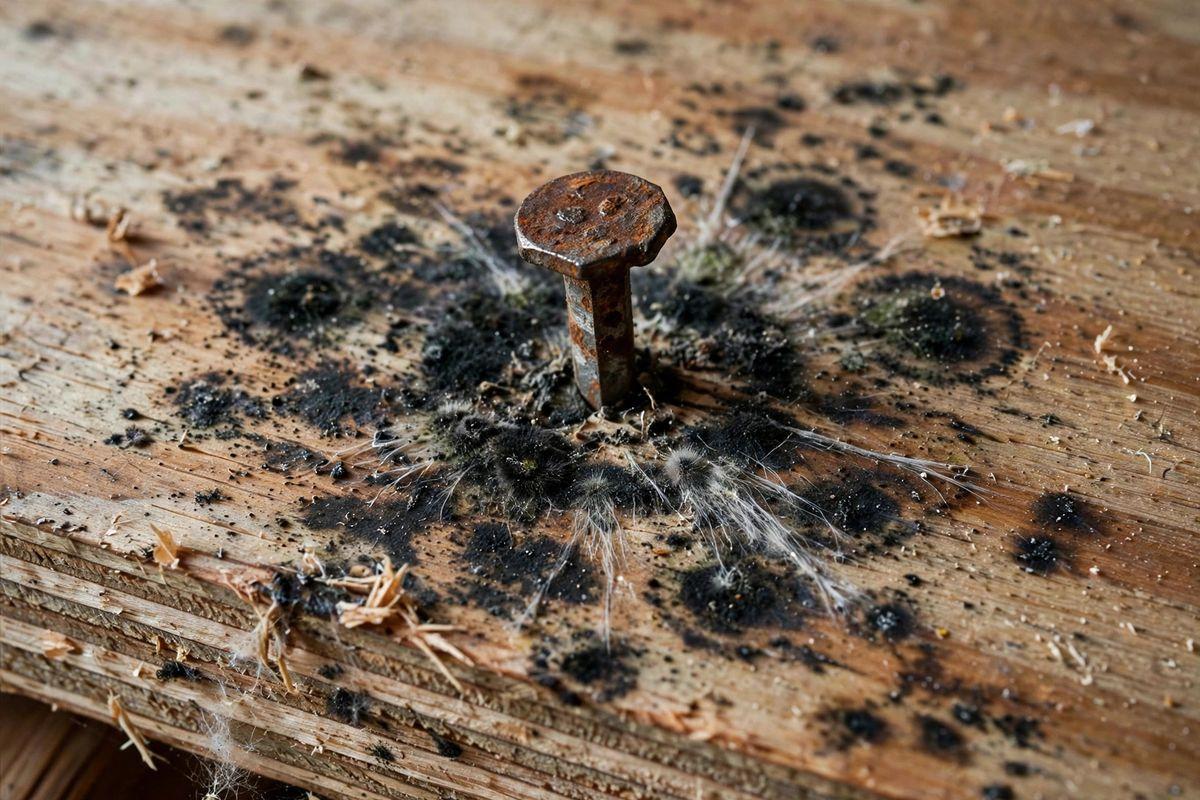
Condensation on roof sheathing. Even without leaks or misvented fans, Smyrna's humidity can drive sheathing condensation. Warm, moist air from the living space migrates upward through recessed lights, attic hatches, and plumbing chases; when it meets sheathing cooled by a winter night, it condenses. Frost on nail tips in winter attics is the visible extreme of this process — and where frost forms, spring mold follows.
Roof-Leak Driven: Tracing Water to Its Entry Point
Finding mold on sheathing is step one; finding where the water enters is the inspection's real value. Our leak-tracing process in Smyrna attics:
- Stain and growth pattern analysis. Water obeys gravity and follows framing. Staining that tracks along a rafter uphill to a roof penetration points to flashing failure at that penetration; broad sheathing discoloration across a slope suggests shingle or underlayment failure; isolated spots near valleys point to valley flashing or debris dams.
- Daylight and penetration check. Every roof penetration — plumbing vents, chimney flashing, skylight curbs, attic fan housings — gets examined from inside for daylight gaps, deteriorated sealant, and rust staining that marks chronic wetting.
- Moisture meter confirmation. We verify active versus historic: a stain that's dry today may be a repaired leak's ghost or a leak waiting for the next storm. Pin meter readings on sheathing and rafters separate the two — critical because remediation scope differs enormously between active and historic.
- Exterior correlation. Where safe and accessible, we correlate interior findings with roof observations — shingle age and condition, flashing integrity, gutter overflow patterns that back water under drip edges.
Smyrna's 1940s–60s ranch stock deserves special attention here: many of these roofs are on their second or third shingle layer, original flashing is long past its service life, and previous owners' patch repairs often mask rather than solve. We read the attic like a history of the roof.
Plywood vs. Plank Sheathing: Reading Mold Patterns
Smyrna's housing eras used different sheathing, and mold behaves differently on each:
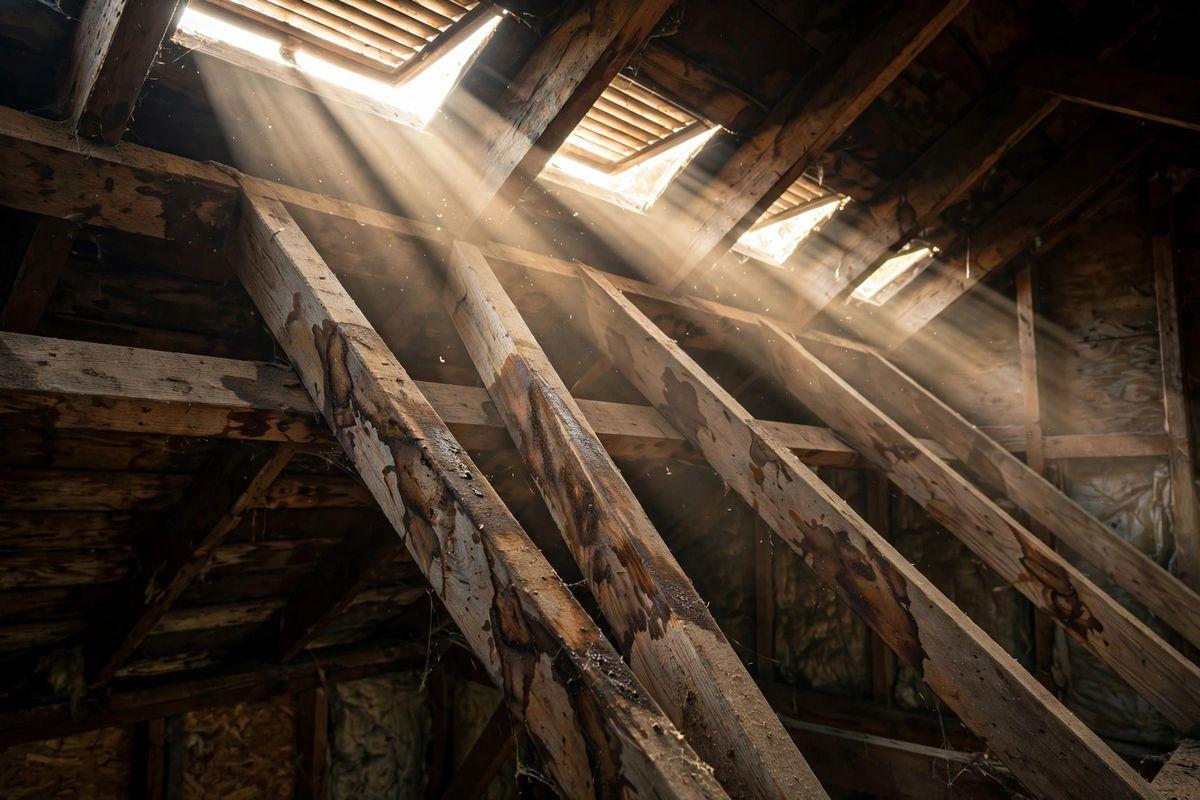
Plywood/OSB sheathing (common in later construction and re-roofed homes). Mold on plywood typically presents as blotchy surface colonization following the wood grain and, distinctively, darkening along the panel seams where moisture wicks into the edges. OSB's wax-and-resin composition resists deep penetration, so growth tends to stay superficial — but swollen, delaminating panel edges signal prolonged saturation that compromises the sheathing itself, a roofing conversation beyond mold.
Plank sheathing (original in many 1940s–60s Smyrna ranch homes — 1x6 or 1x8 boards). Mold on plank sheathing follows the gaps between boards, where air movement and moisture concentrate. The gaps also make leak-tracing easier: water entry points reveal themselves as stained board ends. Plank sheathing's thickness tolerates surface mold well structurally, but the gaps mean attic air — and spores — communicate freely with any space below where ceiling drywall is compromised.
Pattern recognition matters because it distinguishes leak-driven growth (localized, tracking to a source) from condensation-driven growth (diffuse, often on the north-facing slope or around penetrations) from ventilation-failure growth (widespread sheathing colonization with elevated wood moisture content throughout). Each pattern dictates a different fix.
Ventilation Analysis: The Math Behind the Airflow
During the inspection, we evaluate the attic ventilation system as a system:
- Intake vs. exhaust balance. Net free vent area should be roughly balanced between soffit intake and ridge/gable exhaust, with a slight bias toward intake. We document what's installed, what's blocked (painted soffits, insulation-choked baffles), and the resulting imbalance.
- Bathroom and kitchen exhaust terminations. Every exhaust duct gets traced to its termination point. Attic-terminated ducts are flagged as moisture sources regardless of whether mold is currently visible nearby — it's a matter of time in this climate.
- Air sealing of the ceiling plane. Recessed lights, attic hatches, whole-house fan openings, and plumbing chases are checked as the pathways that feed sheathing condensation. In many Smyrna ranch homes, the hatch alone — unweatherstripped, uninsulated — is a significant moisture chimney.
- Powered ventilation assessment. Attic fans and whole-house fans are evaluated for depressurization effects: a powered fan can pull more humid air into the attic from the living space than it exhausts, worsening the problem it was installed to solve.
What the Inspector Checks: The Full Attic Protocol
Our attic mold inspection in Smyrna, GA follows a documented sequence:
- Access and safety — pull-down stair condition, walkability of joists, electrical hazards, wasp nests (common in undisturbed Smyrna attics).
- Systematic visual sweep — sheathing, rafters/trusses, ridge board, gable ends, all penetrations, insulation condition (compressed, displaced, or stained insulation tells the moisture story).
- Moisture mapping — pin meter readings across sheathing zones, rafters near penetrations, and any stained areas; wood moisture content documented against the same thresholds used in our crawl space work.
- Ventilation inventory — intake, exhaust, blockages, exhaust duct terminations, ceiling-plane air leaks.
- Insulation assessment — mold on insulation facing, displaced batts exposing ceiling drywall to attic air, evidence of past water flow through insulation.
- Sampling — tape lift or bulk samples of suspect growth to our accredited third-party lab for genus identification. Full methodology on our mold testing page.
- Source diagnosis and report — written findings separating mold extent from moisture cause, with the fix sequence: roof repair, ventilation correction, exhaust re-routing, air sealing — in the order that makes each step effective.
Attic Mold and Your Home's Value in Smyrna, GA
Attic mold findings surface constantly in Smyrna real estate — and they kill deals when handled badly and barely register when handled well. The difference is documentation. A buyer's inspector notes "possible microbial growth on sheathing"; without a professional assessment, the buyer imagines the worst and either walks or demands a large credit. Our inspection replaces imagination with facts: genus identification from the lab, moisture readings showing active versus historic, and a source diagnosis with a defined fix. Sellers who commission this before listing turn a negotiation liability into a disclosed, quantified, solvable item. In Smyrna's market of older ranch homes where every attic has a story, documented facts beat fear every time.
Attic Mold Inspection Cost in Smyrna, GA
A professional attic mold inspection with moisture mapping and lab sampling in the Smyrna area typically falls in the $300–$600 range for a standard residential assessment. This is not a quote. Steep or complex rooflines, extensive growth requiring multiple samples, or combined attic-plus-interior scopes adjust the work. Smyrna Mold Inspection provides a written estimate before work begins, itemizing the inspection, each sample, and lab fees.
Why Smyrna Homeowners Choose Smyrna Mold Inspection
- IICRC-certified inspectors — Georgia requires no state mold license; certification is the credential that counts, and we hold it.
- Roof-to-sheathing literacy — we trace water to its entry point, not just document the stain where it landed.
- Ventilation expertise — because half of Smyrna's attic mold is an airflow problem wearing a leak's disguise.
- Accredited third-party labs — every sample analyzed independently, never in-house.
- No remediation upsell — we inspect, test, and diagnose. Contractors you choose do the fixing, scoped from our independent report.
Your attic has been keeping secrets — about your roof, your ventilation, and your air. Let's get them documented. Call (770) 542-0091 for an attic mold inspection in Smyrna, GA, email info@moldinspectionsmyrnaga.com, or visit us at 2001 Lake Park Dr SE, Smyrna, GA 30080.
Attic Mold Inspection FAQs — Smyrna, GA
Common indirect signs: musty odors on the upper floor (especially when the HVAC runs), ceiling stains or discoloration, unexplained allergy-like symptoms worse at home, or a roof known to be past its prime. The definitive answer requires looking — which is exactly what the inspection does, safely and systematically.
Yes, through several pathways: ceiling penetrations (recessed lights, hatches, fan openings) allow attic air into living spaces via the stack effect; HVAC equipment or ductwork located in the attic can distribute spores directly; and disturbed growth during roofing work can migrate downward. This is why attic findings often prompt broader assessment.
Not necessarily. Surface mold on structurally sound sheathing is a cleaning/remediation matter once the moisture source is fixed; the roof itself only needs replacement when shingles, flashing, or the sheathing's structural integrity have failed. Our inspection distinguishes the two — active leak versus historic staining, sound sheathing versus delaminated — so you replace what's actually failed.
In Smyrna's climate, it's one of the highest-value fixes a homeowner can make — every shower feeds the attic moisture load directly. Re-routing the duct through the roof or gable wall (with insulated duct to prevent condensation inside the duct itself) is straightforward work for a qualified contractor, and it removes a chronic moisture source regardless of whether mold is currently visible.
It depends on the cause and your policy: sudden, accidental water damage (a storm-created roof opening) is viewed differently from long-term maintenance issues (deteriorated flashing over years). Our documented report — with moisture readings, lab results, and source diagnosis — gives your adjuster the objective basis a claim decision requires. Review your policy language with your agent.
Either party can commission one, and the strategic logic differs: sellers get ahead of the issue with documented facts before listing; buyers get independent verification during due diligence when the general inspection flags staining or moisture. In practice, whoever needs the certainty most should order it — the report serves both sides of the transaction.
Related Mold Inspection Services in Smyrna, GA
Indoor Air Quality Testing
Room-by-room spore counts to check whether attic mold is migrating indoors.
Learn more →