
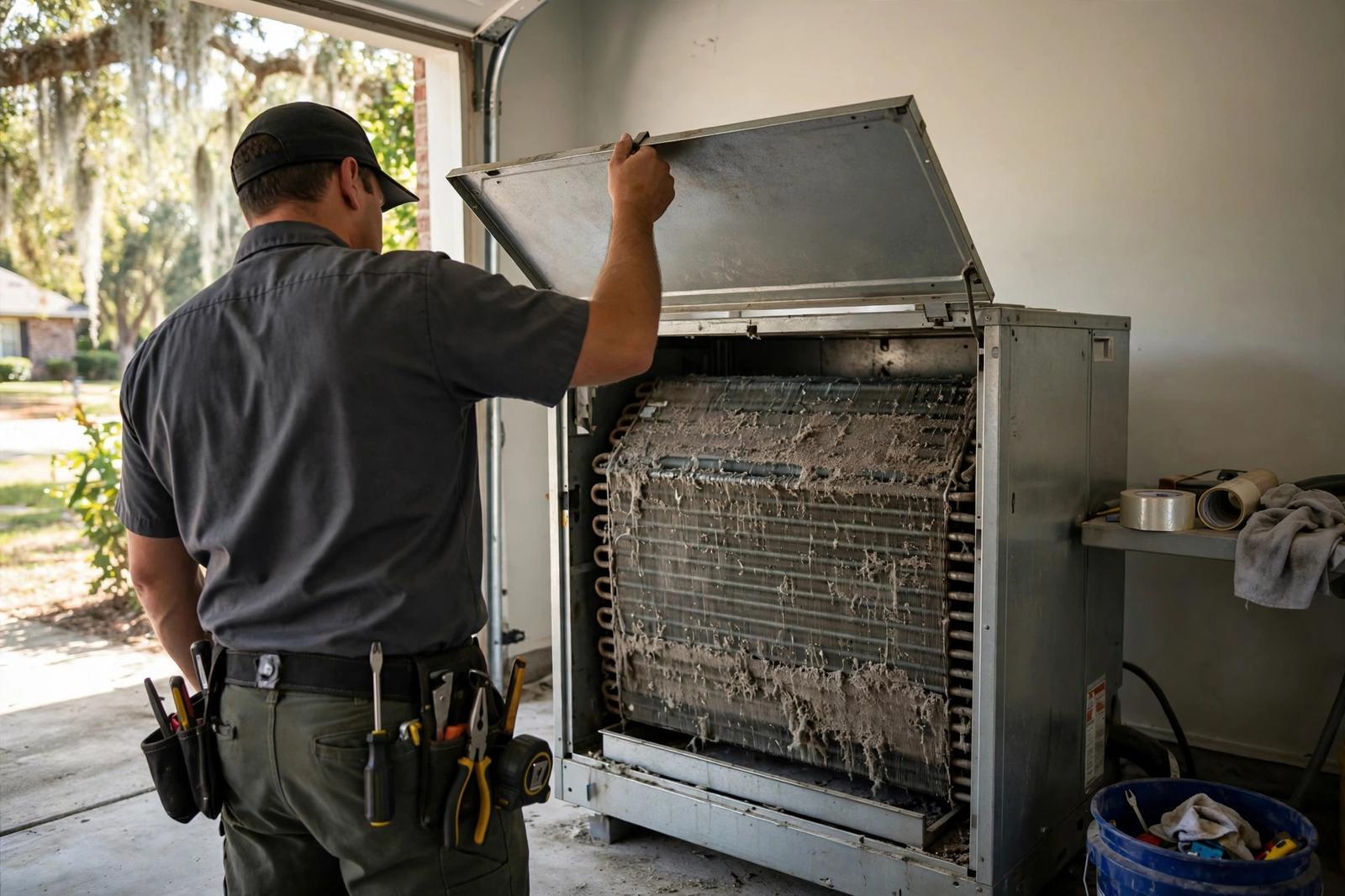
Your heating and cooling system moves every cubic foot of air in your home through the same ductwork, coils, and drain pans several times a day. When mold establishes itself anywhere in that airstream — on a condensate-soaked evaporator coil, inside a flex-duct liner, or across a dust-loaded supply plenum — the HVAC system stops being just a comfort appliance and becomes a distribution network. An HVAC mold inspection in Smyrna, GA is a targeted assessment of the ductwork, air handler, coils, and drainage components where moisture and organic debris meet.
Smyrna's humid subtropical climate makes this inspection especially relevant. With ~70% average humidity, ~50 inches of annual rain, and long cooling seasons, Smyrna air handlers run for months at a time in conditions that keep coils wet and condensate lines flowing. Call Smyrna Mold Inspection at (770) 542-0091 to schedule.
Why HVAC Systems in Smyrna, Georgia Grow Mold
Mold needs three things: moisture, food, and time. Smyrna HVAC systems provide all three in abundance:
- Constant condensation. Every cooling cycle drops the evaporator coil well below the dew point. In a climate with 70% ambient humidity, coils and drain pans stay wet for hours after each cycle, and supply plenums in unconditioned attics and crawl spaces sweat on their exterior surfaces.
- Organic food sources. Dust, skin cells, pollen, and the cellulose in duct board and flex-duct liners feed Cladosporium, Aspergillus, and Penicillium colonies readily.
- Dark, undisturbed interiors. Duct interiors are dark, rarely disturbed, and in the right temperature band — ideal colonization conditions that persist for years between any kind of access.
- Long runtimes. Smyrna cooling seasons stretch from spring deep into fall. More runtime means more condensate, more wet hours on the coil, and more air circulated past any established growth.
- Crawl space and attic exposure. Many Smyrna homes run ductwork through vented crawl spaces or hot attics — both environments with their own moisture problems that transfer directly onto duct surfaces.
What Our HVAC Mold Inspection in Smyrna, GA Covers
Air Handler and Blower Compartment
We inspect the air handler cabinet interior — blower wheel, blower housing, cabinet insulation, and wiring compartments — for visible colony growth, dust loading, and moisture. The blower wheel in particular is a common reservoir: fine dust accumulates on the blades, and in humid return air that dust stays damp enough to support Aspergillus and Cladosporium growth that then sheds spores into the supply airstream with every cycle.
Evaporator Coil Condition
A dirty evaporator coil is one of the most consequential findings in any HVAC mold inspection in Smyrna, GA. Coils collect dust and biofilm over years of operation; that mat of organic material stays perpetually damp during cooling season and becomes a living colony surface. We assess coil fouling, fin condition, and visible growth, and we document it photographically — a fouled coil both harbors mold and degrades system efficiency, so this finding pays for itself twice.
Condensate Drain Pans and Drain Lines
Clogged condensate drains are a classic Smyrna problem. Algae, slime, and sediment build up in drain lines; the pan overflows or the line backs up, and standing water sits in the pan for days. Stagnant condensate pans grow thick biofilm — often the source of the "dirty sock" or musty odor homeowners notice. We inspect pan condition, drain line flow, trap configuration, and signs of historical overflow staining inside the cabinet and on surrounding surfaces.
Supply and Return Ductwork
We inspect accessible supply and return ductwork, with special attention to:
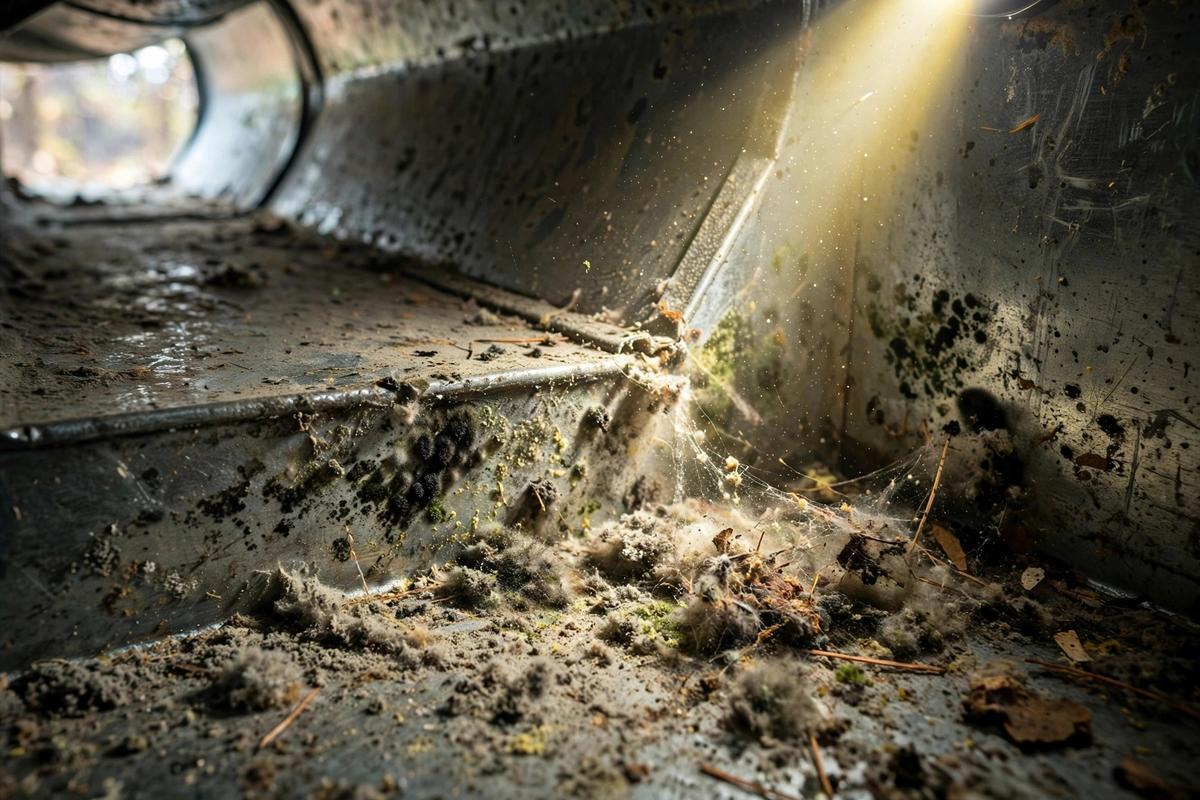
- Flex-duct inner liners. The fiberglass core and plastic liner of flexible duct in Smyrna attics and crawl spaces can trap moisture where the liner sags or where insulation has compressed. Once the inner liner supports growth, it cannot be effectively cleaned — replacement of the affected run is the only reliable fix, and our inspection identifies exactly which runs are affected.
- Duct board (fiberglass duct). Older duct-board systems in Smyrna's 1940s–1970s homes have porous fiberglass interiors that absorb moisture and harbor colonies deep in the fiber matrix. We assess whether the duct board is intact, damp, or colonized.
- Sheet metal trunks and takeoffs. Metal duct doesn't feed mold itself, but the dust layer inside it does, and leaking joints pull humid attic or crawl space air into the system. We check joint sealing, insulation integrity, and interior dust loading at accessible points.
The Musty Odor When the System Cycles On
One of the most common reasons Smyrna homeowners call us is a musty smell that appears every time the air conditioner kicks on, then fades. That pattern is diagnostically significant: it points to a reservoir inside the air handler or supply ductwork — coil biofilm, a slimy drain pan, or colonized duct liner — that releases a burst of microbial volatile organic compounds (MVOCs) when airflow starts. Our HVAC mold inspection in Smyrna, GA is designed to trace that odor to its source rather than mask it.
Condensation on Supply Plenums
In Smyrna's vented crawl spaces and unconditioned attics, the cold supply plenum sweats during cooling season. Chronic exterior condensation drips onto surrounding insulation, wood framing, or crawl space soil — creating secondary mold reservoirs outside the duct system that feed spores back into return leaks. We document plenum sweating and the condition of surrounding materials as part of the inspection.
Filters, Filter Racks, and Return Air Pathways
We evaluate filter type and condition, filter rack sealing (bypass air around a poorly fitted filter carries unfiltered dust straight to the coil), and the return air pathway. Return plenums and filter racks in dusty garages, crawl spaces, or laundry rooms load coils faster and deserve closer attention.
Why HVAC Inspection Pairs with Air Sampling
A visual HVAC inspection finds what the eye and the camera can reach — but duct interiors run for dozens of feet behind walls, above ceilings, and under floors. That's why an HVAC mold inspection in Smyrna, GA pairs naturally with indoor air quality testing: air cassette samples taken at supply registers capture what the system is actually distributing, and comparing register samples against an outdoor baseline and a room-center sample reveals whether the HVAC system is amplifying indoor spore counts. When register counts run significantly higher than ambient room air, the duct system is implicated — even if the visible portions looked clean. We also offer standalone mold testing (surface and cavity sampling) when a specific component, like a coil or drain pan, needs laboratory confirmation.
HVAC Mold and Your Crawl Space
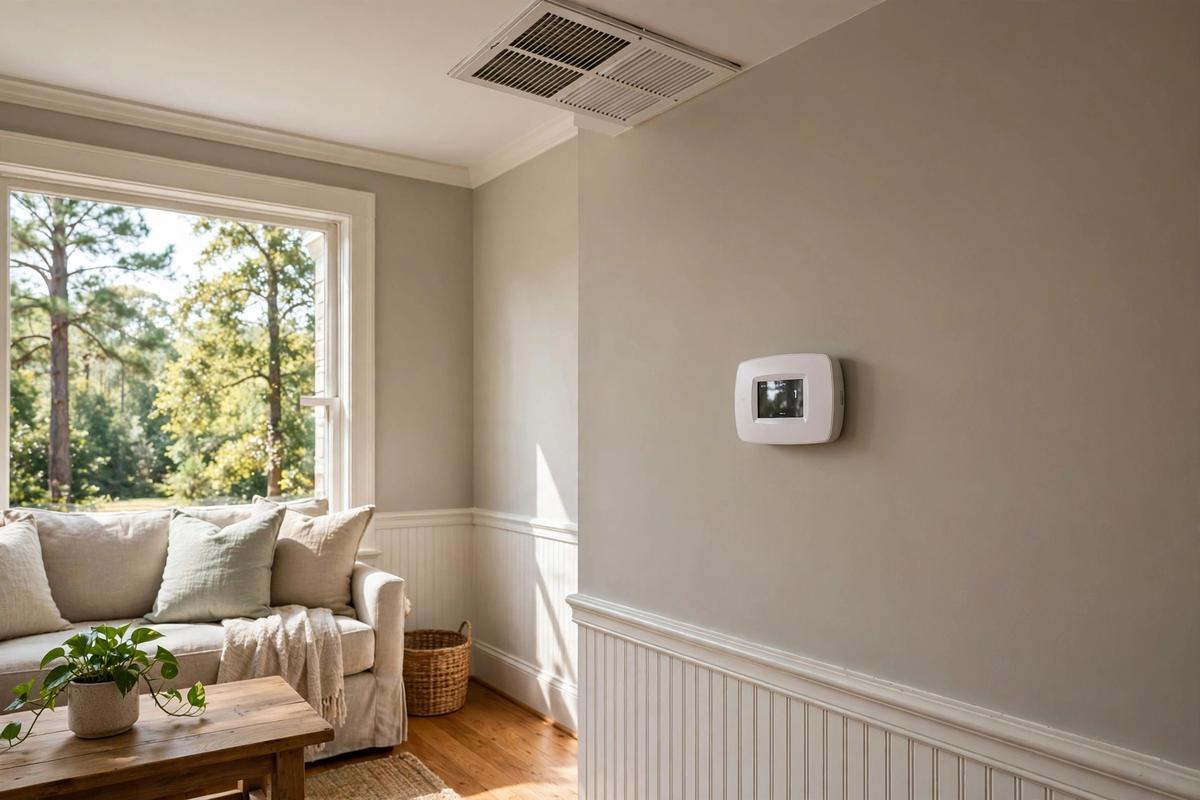
In many Smyrna ranch homes, the air handler sits in the crawl space or the ductwork runs through it — and vented crawl spaces are the #1 mold reservoir in local housing. A crawl space with standing moisture, saturated soil, or visible growth on floor joists will contaminate any ductwork and equipment housed there. If your system lives in or breathes from a crawl space, consider our crawl space assessment alongside the HVAC inspection so both sides of the problem are documented together.
When to Schedule an HVAC Mold Inspection in Smyrna, Georgia
Call (770) 542-0091 if you notice:
- Musty, earthy, or "dirty sock" odor when the system starts
- Visible growth or heavy dust inside the air handler or on vents
- Water staining around the air handler, on ceilings below attic equipment, or on the condensate line
- Allergy or respiratory symptoms that worsen indoors or when the system runs
- A system that hasn't been professionally inspected in several years
- Recent water intrusion anywhere near ductwork or equipment
- You're buying a Smyrna home and want the HVAC system assessed beyond a standard home inspection
What the Inspection Report Includes
Every HVAC mold inspection in Smyrna, GA concludes with a written report: component-by-component findings with photographs, coil and drain pan condition assessment, ductwork evaluation by material type and location, moisture readings at key points, laboratory results for any air or surface samples, species identification for confirmed growth, and prioritized recommendations — from coil cleaning and drain line clearing through duct replacement scope where warranted. Any cost figures discussed are broad ranges only (for example, a typical coil cleaning or duct-run replacement discussion stays in general ranges) — this is not a quote, and any contractor you hire should provide a written estimate before work begins.
Please note: All prices on this page are broad ranges only — not a quote. Request a written estimate before work begins; the written estimate is confirmed in writing before any work starts.
Frequently Asked Questions
Pricing depends on system size, accessibility of ductwork, and the number of laboratory samples (register air samples, coil surface samples). Most residential HVAC inspections with air sampling fall in a broad range of roughly $300–$600. This is not a quote — call (770) 542-0091 for a written estimate before work begins.
Mold exposure can trigger allergic reactions, asthma symptoms, and respiratory irritation in sensitive individuals. An HVAC system distributing spores throughout the home increases exposure compared to a contained reservoir. If occupants have symptoms that improve when away from home, an HVAC mold inspection in Smyrna, GA is a sensible next step.
Duct cleaning without inspection is guesswork. If the coil is fouled, the drain pan is slimy, or flex-duct liners are colonized, cleaning the metal trunks won't resolve the source — and aggressive cleaning of contaminated flex duct or duct board can damage it. Inspect first, then scope the right corrective work.
Given the humidity and long cooling seasons, we recommend a professional look every 2–3 years, and immediately after any water event near the equipment, any musty-odor onset, or before buying a home. Homes with crawl-space-mounted equipment merit closer intervals.
Register air samples compared against outdoor and room baselines are the best non-invasive indicator of whether the HVAC system is distributing elevated spores. Paired with visual inspection of the coil, pan, and accessible ductwork, it gives a complete picture — which is why we recommend the combination.
Georgia has no state mold license. Vet inspectors on credentials and protocol instead: IICRC certification, documented moisture mapping, and laboratory-confirmed testing are the marks of a professional inspection, and they're the standard we work to on every job.
Smyrna Mold Inspection — 2001 Lake Park Dr SE, Smyrna, GA 30080 | (770) 542-0091 | info@moldinspectionsmyrnaga.com