
Indoor Air Quality Testing in Smyrna, GA: What's Really in Your Air
You can't see what's in your air — but in Smyrna, GA, there's almost always something. This is a humid subtropical city with no dry season, ~70% average humidity, and a long growing season under a dense tree canopy. Outdoor mold spore counts here run high for much of the year, and every time your front door opens, that outdoor air comes inside. The question indoor air quality testing in Smyrna, GA answers isn't "is there mold in my air" — of course there is. The question is whether your indoor air carries an abnormal mold burden compared to Smyrna's outdoor baseline, and whether your home's systems are amplifying it.
 Independent • Third-Party
Smyrna Mold Inspection performs professional indoor air quality testing for mold-related concerns across Smyrna and Cobb County — spore trap air sampling with accredited third-party lab analysis, HVAC contribution assessment, and plain-language interpretation. If your household's allergy symptoms flare at home, if a musty odor follows you room to room, or if you simply want to know what you're breathing, call (770) 542-0091.
Why Indoor Air Quality Testing Matters More in Smyrna, Georgia
National IAQ advice assumes average conditions. Smyrna's conditions aren't average:
Year-round outdoor spore load. In drier climates, winter brings a natural reset — frozen ground, dormant vegetation, low spore counts. Smyrna's mild winters and extended growing season mean Cladosporium, Alternaria, and other outdoor fungi stay active nearly year-round. Your home's indoor air is constantly exchanging with spore-rich outdoor air, so "normal" here looks different from "normal" in Denver or Minneapolis. Testing that doesn't account for the local outdoor baseline misreads the entire picture.
Humidity that never fully releases. With no dry season and ~50 inches of annual rain, Smyrna homes battle indoor humidity constantly. Air conditioning wrings moisture from the air all summer — but oversized systems that short-cycle cool the air without dehumidifying it, leaving indoor relative humidity in the 60%+ range where dust mites thrive and mold amplifies on any available organic surface.
Flood and storm legacy. The September 2009 flood (Rottenwood Creek at 11.74 feet), recurring tropical events, and the September 2026 flash floods left a legacy of water intrusion across Smyrna's housing stock — damp wall cavities, saturated subfloors, and crawl spaces that never fully dried. Hidden reservoirs like these continuously seed indoor air with spores long after the visible cleanup ended.
Aging housing stock. Smyrna's 1940s–60s brick ranch homes — charming, solid, and full of original ductwork, aging insulation, and decades of accumulated dust in wall cavities — interact with this climate in ways new construction doesn't. Add Cumberland-area apartments and condos with shared HVAC infrastructure, and you have a city where indoor air deserves professional attention.
Elevated Indoor Spore Counts vs. the Outdoor Baseline
This is the central concept of mold-related air quality testing, and the one most DIY test kits get wrong.
A spore trap cassette captures a measured volume of your indoor air — typically 75 to 150 liters over several minutes — and the accredited lab counts and identifies every spore on the slide, reported as spores per cubic meter. But the raw number is meaningless alone. Every professional appointment includes an outdoor control sample collected the same day, under the same weather conditions.
The interpretation framework:
- Indoor counts at or below outdoor, same genera — normal air exchange. Your home is breathing Smyrna's outdoor air, filtered to whatever degree your HVAC manages. No indoor amplification indicated.
- Indoor counts moderately above outdoor — possible indoor contribution; warrants investigation of humidity, HVAC hygiene, and hidden moisture.
- Indoor counts substantially exceeding outdoor, or indoor-dominant genera (Aspergillus/Penicillium elevated while outdoor Cladosporium dominates) — the classic signature of an indoor mold source actively releasing spores into your living space.
- Water-indicator genera indoors (Stachybotrys, Chaetomium) even at low counts — points to chronic moisture and hidden growth, since these heavy spores don't travel far from their source.
Because Smyrna's outdoor counts swing with weather — a rainy week versus a dry stretch, mowing season, leaf decay — the same-day control is non-negotiable. A test without it is just a number.
Your HVAC: Filter, Circulator, or Contaminant Source?
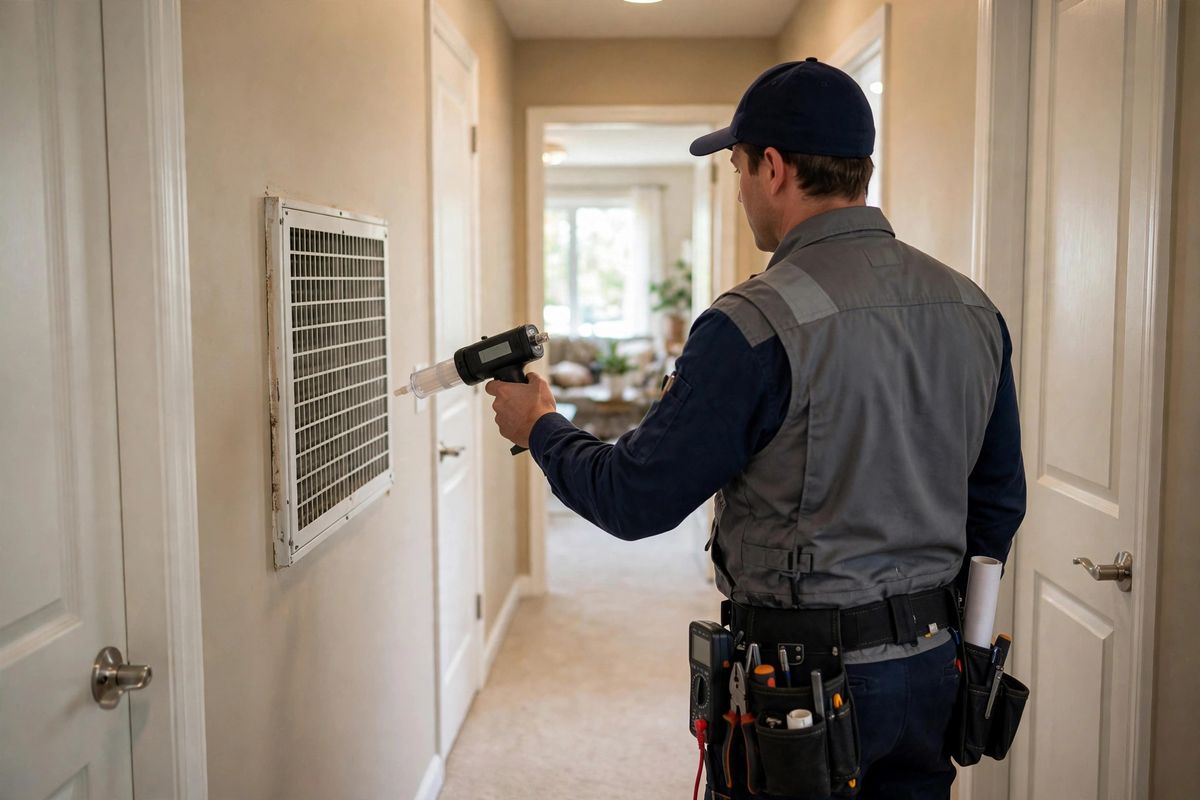
In Smyrna's climate, the HVAC system runs most of the year — and whatever grows inside it gets distributed to every room it serves. During indoor air quality testing, we assess the HVAC's role directly:
The evaporator coil and drain pan. Constant condensation keeps these components wet. Without regular maintenance, the coil and pan grow biofilm — a mix of mold, bacteria, and accumulated dust — that sheds spores into the supply airstream every cycle. The musty blast when the system kicks on is the telltale sign.
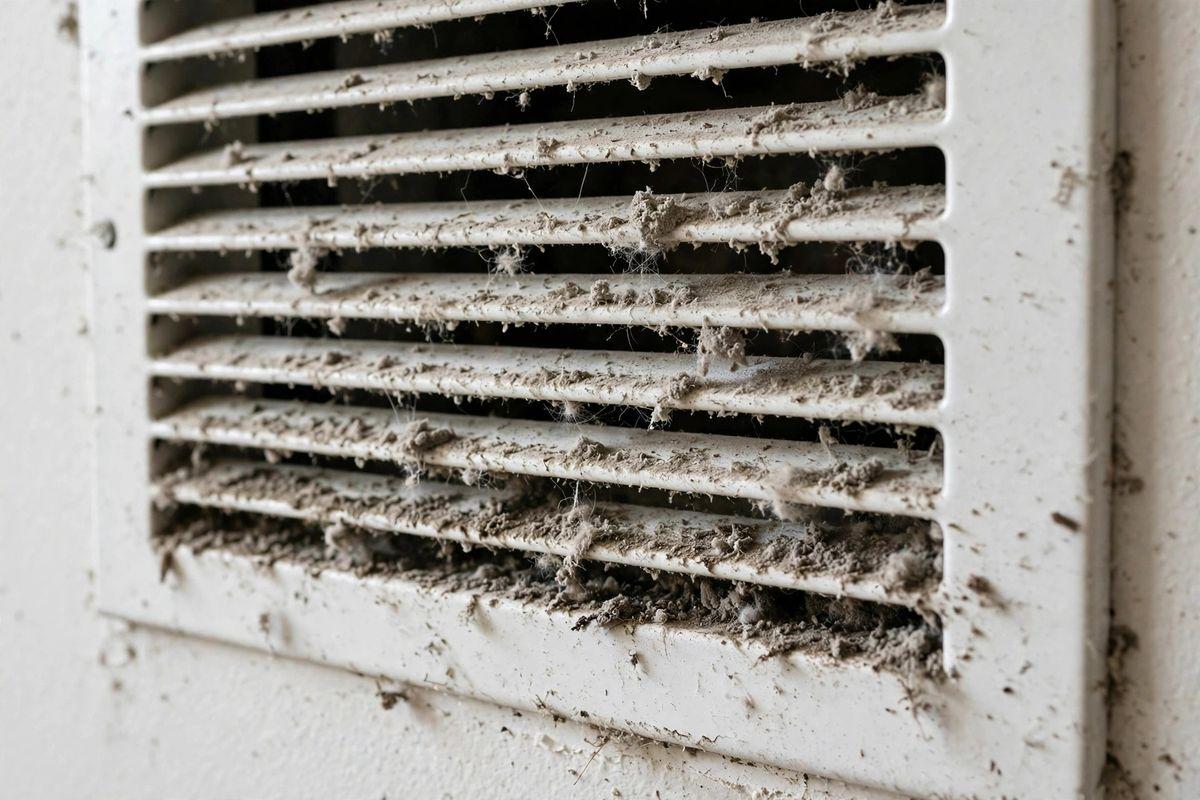
Ductwork. Original ducts in Smyrna's mid-century ranch homes have had 60+ years to accumulate dust — organic food for mold whenever humidity spikes. Flexible duct in attics and crawl spaces is vulnerable to condensation on its outer jacket and microbial growth at connection points. We inspect accessible duct interiors and can sample them directly.
Filtration. Many Smyrna homes still run basic 1-inch fiberglass filters that catch large dust but pass mold spores freely. Filter slot bypass — air sneaking around an ill-fitting filter — is common and defeats even good filters. We evaluate what's installed and whether it's actually sealing.
Return placement. A return grille pulling air from a musty crawl space access or a damp utility closet imports that contamination into the whole system. Placement matters as much as filtration.
This HVAC focus is why we recommend pairing air quality testing with a dedicated HVAC mold inspection when system contamination is suspected — the air test documents what's in the air, and the HVAC inspection finds where in the system it's coming from.
MVOCs: The Science Behind the Musty Smell
That unmistakable musty odor — the one that hits you opening a Smyrna crawl space hatch or walking into a long-closed room — has a chemical name: microbial volatile organic compounds (MVOCs). Actively growing mold releases these gases as metabolic byproducts. The human nose detects some MVOCs at extraordinarily low concentrations, which is why you can smell a problem long before you can see one.
MVOCs matter for testing strategy in two ways. First, odor without visible growth is a legitimate trigger for testing — it often indicates hidden colonization inside wall cavities, under flooring, or in HVAC components. Second, odor location guides sampling: we place cassettes where MVOCs concentrate, because that's where the source is nearest. During your appointment, we'll ask you to note exactly where and when odors are strongest — morning versus evening, HVAC on versus off, after rain. Those details are diagnostic.
Who Benefits Most from Indoor Air Quality Testing in Smyrna, GA?
- Allergy and sensitivity sufferers. If sneezing, congestion, itchy eyes, or sinus pressure intensify at home and ease elsewhere, IAQ testing documents whether indoor mold burden is a plausible contributor. (We make no medical claims — bring our lab report to a medical professional to discuss symptoms.)
- Families with children. Kids breathe more air per pound of body weight and spend more time on floors where settled spores concentrate. Parents across Smyrna's family neighborhoods use testing for peace of mind — or to justify action when a landlord or builder dismisses concerns.
- Post-illness and post-remediation households. After a respiratory illness or a completed remediation project, testing verifies the indoor environment before vulnerable occupants return to normal routines. Pair with clearance testing after any remediation work.
- Homebuyers. Smyrna's competitive market moves fast, and general home inspections don't sample air. Testing during due diligence — especially on flood-plain-adjacent properties or older ranch homes — is inexpensive insurance against inheriting someone else's hidden moisture problem. Our general mold testing page details sampling methods used in these assessments.
- Tenants in dispute. When a landlord insists a musty Cumberland apartment is "fine," an accredited lab report is objective evidence that moves conversations forward.
What the Testing Appointment Involves
A standard indoor air quality testing appointment in Smyrna runs about 1–2 hours:
- Interview — symptoms, odors, timing, moisture history, HVAC age and maintenance. Your observations shape the sampling plan.
- Walkthrough — visual check of complaint areas, HVAC components, and moisture-prone zones (crawl space access, attic hatch, bathrooms, laundry).
- Sampling — spore trap cassettes placed per strategy: typically one outdoor control, one to three indoor locations (complaint area, main living space, near HVAC return), plus surface samples if visible growth is found.
- HVAC assessment — filter, coil access, drain pan, duct connections, and return placement evaluated.
- Chain of custody — cassettes sealed, labeled, and shipped to the accredited third-party lab the same day. We never analyze samples in-house — independence is what makes results credible.
- Report — lab results in 2–3 business days (rush available), with our plain-language interpretation: what the indoor/outdoor comparison shows, which genera dominate, and recommended next steps.
Preparation: keep HVAC running normally, avoid heavy cleaning or airing out the house for several hours beforehand, and note when and where odors are strongest. We'll confirm prep details when you schedule.
Indoor Air Quality Testing Cost in Smyrna, GA
Professional IAQ testing with accredited lab analysis in the Smyrna area typically falls in the $300–$600 range for a standard residential appointment, depending on home size and number of samples. This is not a quote. Complex layouts, multi-zone HVAC systems, or added surface sampling adjust the scope. Smyrna Mold Inspection provides a written estimate before work begins so every sample and fee is itemized upfront.
Why Smyrna Homeowners Choose Smyrna Mold Inspection
- Accredited third-party labs on every sample — never in-house analysis.
- IICRC-certified inspectors — Georgia requires no state mold license, so we hold the industry certification that actually means something.
- Smyrna-calibrated interpretation — we read your results against this city's real outdoor baseline, not a national generic threshold.
- HVAC-inclusive approach — because in this climate, the air handler is half the air quality story.
- Independent — we test and inspect; we don't sell remediation, so our findings come with zero upsell pressure.
If your home doesn't smell right, feel right, or test right — let's find out what's actually in the air. Call (770) 542-0091 for indoor air quality testing in Smyrna, GA, email info@moldinspectionsmyrnaga.com, or visit 2001 Lake Park Dr SE, Smyrna, GA 30080.
Indoor Air Quality Testing FAQs — Smyrna, GA
A good HEPA purifier reduces airborne spore levels in the room it serves, but it treats the symptom, not the source. If hidden mold in a wall cavity or crawl space keeps releasing spores, the purifier runs forever while the colony grows. Test first, find the source, fix it — then decide if supplemental filtration makes sense.
You can't determine that from air testing alone — and neither can we. What testing provides is objective data on your indoor mold burden relative to Smyrna's outdoor baseline. Share the lab report and your symptom patterns with a medical professional; that combination is far more useful than either piece alone.
Visible growth is usually better served by surface sampling (tape lift or swab) to identify the genus, plus inspection to find the moisture source — see our mold testing page. Air sampling adds value when you also want to know whether spores are migrating beyond the visible area, such as into bedrooms or through the HVAC.
Our testing focuses on mold-related air quality: spore counts, genera, and MVOC-odor investigation. Volatile organic compounds from building materials, formaldehyde, and radon require different specialized testing. If your concerns extend beyond mold, ask us during scheduling and we'll advise on the right specialist.
There's no fixed schedule — test when something changes: new or worsening odors, new symptoms, after flooding or major leaks, before/after remediation, or during a real estate transaction. Annual HVAC maintenance with coil and drain pan cleaning does more for everyday air quality than repeated testing of a healthy home.
Yes — and in Smyrna's Cumberland-area multifamily buildings it's frequently requested. We test your unit's air and can assess your HVAC closet or fan-coil unit. Note that shared building systems and neighboring units can influence results; we'll note those factors in the report, which is useful documentation if you're working with property management.
Related Mold Inspection Services in Smyrna, GA
HVAC Mold Inspection
Coil, drain pan, and ductwork inspection to find system-borne contamination.
Learn more →Attic Mold Inspection
Roof-leak tracing and ventilation analysis for hidden attic growth.
Learn more →